A 2025 analysis published in the International Journal of Financial Studies drew a clear, direct correlation between corporate social responsibility (CSR) and performance: Put simply, companies that win in CSR outperform their peers.
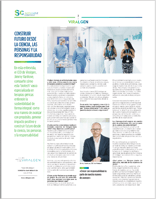 It’s a business dynamic that Viralgen CEO Jimmy Vanhove knows well. He explained the value of looking at sustainability from a holistic perspective in a recent Q&A with El Diario Vasco, one of the Basque Country’s leading daily newspapers.
“For us, sustainability is also measured by how we care for the people who make Viralgen possible,” Vanhove reports. “ This means offering a safe, respectful and demanding environment where every person can grow and contribute with a sense of purpose.”
Click here to read the original Spanish-language interview, or keep reading below for the English translation.
Viralgen works on rare and ultra-rare diseases. How does this connect with the social dimension of sustainability?
This is probably where our mission and our social responsibility come together most clearly. At Viralgen, we work to help treatments reach the people who need them sooner, and that purpose has, in itself, a very deep social dimension. But our commitment is not limited to our industrial activity. We also strengthen collaboration with foundations and associations linked to rare and ultra-rare diseases, including those managed by families themselves. At the same time, we continue to drive continuous improvement in our processes, because we also believe that gaining efficiency is a way to generate greater positive impact.
What are Viralgen’s specific environmental commitments through 2030? Are there measurable targets?
Our environmental plan is structured around three priorities, with the aim of reducing the negative impact we generate: lower emissions, less waste and a more sustainable value chain.
We have set the target of reducing direct greenhouse gas emissions by 20%, combining energy efficiency with renewable sources such as photovoltaics. At the same time, we continue to improve waste management and review processes from a circularity perspective.
In addition, we are integrating sustainability criteria into suppliers and services, because Scope 3 emissions—those generated across the supply chain—are not separate from our responsibility; they are part of it.
How does Viralgen care for its own team within this sustainability plan? Are there specific actions for the people who work here?
For us, sustainability is also measured by how we care for the people who make Viralgen possible. This means offering a safe, respectful and demanding environment where every person can grow and contribute with a sense of purpose.
Our plan toward 2030 includes specific actions in talent, leadership, diversity and inclusion, health, safety and well-being. These are not isolated initiatives, but commitments embraced by leadership.
In a sector as highly regulated as gene therapy, what does “good governance” mean for Viralgen? Isn’t it already guaranteed by the regulatory framework?
Regulatory compliance is the floor, not the ceiling. Sustainability is only possible through coherence, and that requires going far beyond what the law demands. Our governance plan is based on the involvement of the leadership team at every level, not as supervisors, but as active drivers of an ethical and responsible culture.
We work closely with regulatory bodies at regional, national and international levels, ensuring compliance while also anticipating the standards of the future. We are working to simplify and align our anti-corruption framework, with ongoing training and awareness programs tailored to all profiles across the organization.
Cybersecurity appears in your governance plan. Why is it part of the sustainability agenda?
Because trust is a sustainability asset. A cybersecurity breach is not just a technical problem; it affects the rights of many people and can undermine years of credibility built with patients, partners and regulators.
That is why we are actively strengthening our ability to protect data across the full scope of our activity. And we go further: we have specific workstreams to anticipate future uses of Artificial Intelligence and ensure that technological adoption at Viralgen is always ethical, safe and responsible.
What does Viralgen want to be ten years from now, beyond the 2030 goals?
Ten years from now, above all, we want to continue transforming lives through our science, making it possible for new therapies to reach the market and become commercially available to the patients who need them. We also want to do so as a company that generates a positive and measurable impact on our environment and society, capable of growing and adapting responsibly.